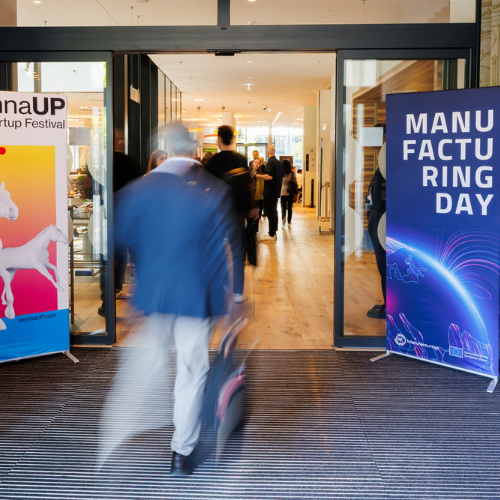
From AI-powered factories to hard-tech scale-ups, ViennaUP’s flagship manufacturing event brought together the people building Europe’s next industrial era.
Industrial transformation is no longer a future scenario discussed in strategy papers and keynotes; it is happening now, in factories, research labs, universities and startups across Europe. At Manufacturing Day 2026, held as part of ViennaUP, that transformation became tangible.
More than 500 participants from over 50 countries gathered in Vienna for one of Europe’s leading events dedicated to advanced manufacturing, industrial AI, deep-tech entrepreneurship, and industrial scale-up. Throughout the day, founders, corporates, investors, researchers, and policymakers debated a question that increasingly defines Europe’s economic future: how can Europe turn world-class industrial innovation into globally competitive manufacturing companies?
The answer, according to many speakers, lies somewhere between technology, capital, collaboration, and the willingness to rethink industrial systems from the ground up.
Startups pitch the next generation of industry
The energy of the event was especially visible during the startup pitch competition, where six startups presented technologies addressing some of manufacturing’s most urgent challenges: automation, sustainability, industrial efficiency, and resilient production systems.
The winning startup, factorymaker, who develops AI-powered software for industrial plant design and optimisation, stood out for its ambitious vision to automate production layout, building, and site planning workflows in a holistic way to enable faster, more cost-efficient, and sustainable factory planning. In a field packed with technically strong companies, the jury praised factorymaker’s combination of industrial relevance, scalability, and practical applicability; qualities increasingly essential in today’s manufacturing landscape. As winner of the competition, founder Dr. Julia Reisinger took home a € 5,000 award, sponsored by the Wirtschaftsagentur Wien, to support their European expansion strategy.
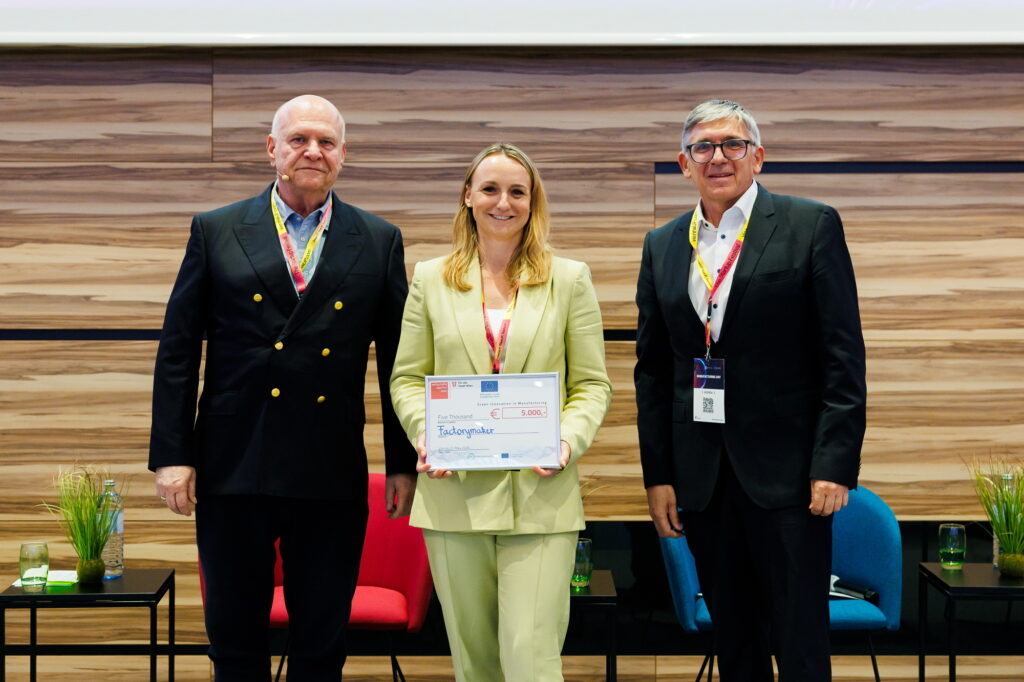
Factorymaker won the Manufacturing Innovation Award (Hannes Hunschofsky, Julia Reisinger, Peter Kuen)
The competition reflected a broader shift in European manufacturing innovation. Rather than focusing purely on software or digital platforms, many startups showcased technologies deeply connected to physical industry: robotics, industrial AI, production infrastructure, hardware-enabled platforms, and sustainable manufacturing processes.
This “return to industry” became one of the defining themes of the day.
Corporates are no longer waiting for innovation, they’re opening the door
One of the clearest signals from Manufacturing Day 2026 was that large industrial players are actively searching to work with startups.
Marta Provera from De Nora (Edge – Innovation Hub by De Nora) introduced their Edge Call for Startups 2026: Re-Designing Industrial Operations, inviting early-stage companies to bring solutions into real industrial environments. The programme focuses on improving manufacturing efficiency, automation, safety, and resource optimisation, offering startups access to De Nora’s global operations, expert teams, and industrial facilities for validation and pilot projects, along with up to € 50,000 in funding.
Andreas Muehlberger from Infineon Technologies presented their Startup Challenge 2026: Humanoid Robots, focusing on enabling technologies for next-generation robotics. Key areas include robotic simulation, environmental sensing systems, tactile and feedback technologies, and advanced motor control. Selected startups progress through a programme involving pitching opportunities, technical and business support with ecosystem partners, and a final Demo Day in October at EBSCON in Graz.
Rather than traditional corporate presentations, the session functioned almost as public calls for partnership. For startups in the audience, the message was clear: industrial corporates are increasingly willing to work externally to solve problems related to automation, energy efficiency, digitalisation, and resilient supply chains.
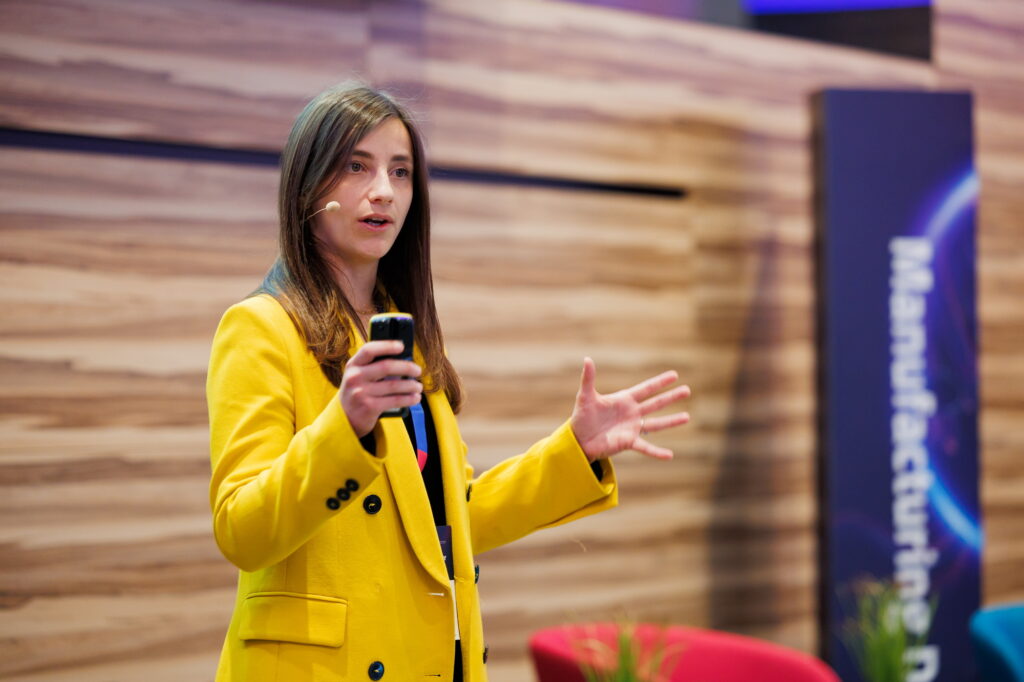
Marta Provera presenting De Nora’s Edge Call for Startups
Additional perspectives came from EY (Christoph Mayer), who explored how physical AI will drive the next Industrial Revolution, and Ján Matejčík from TOMARK s.r.o., who was looking for technology partners focused on 3D scanning and digital part recognition to support logistics and production-line picking operations.
Overall, the session painted a picture of an industrial sector moving away from closed innovation models toward more collaborative ecosystems.
Europe’s industrial problem is no longer innovation, it’s scale
A special video message from Michiel Scheffer 🇪🇺, President of the Board of the EIC – European Innovation Council, reinforced the strategic importance of industrial innovation for Europe’s future competitiveness. He emphasised the importance of collaboration and the need to help deep-tech startups scale within Europe rather than losing them to foreign markets.
Throughout the day, one topic repeatedly resurfaced in conversations on stage and in networking sessions: Europe’s scale-up gap. Europe produces outstanding industrial research, engineering talent, and deep-tech innovation. Yet many manufacturing ventures struggle to grow from successful prototypes into globally competitive industrial companies.
That challenge became the focus of the afternoon keynote by David Mindell, Professor at Massachusetts Institute of Technology (MIT), Investor at Unless and Founder of Humatics, and one of the most prominent voices on the future of industrial systems. In his keynote, “From the Lunar Society to a New Industrialism,” Mindell drew historical parallels between today’s AI revolution and the first Industrial Revolution. But rather than presenting AI as a force that simply replaces labour, he argued that industrial revolutions historically create entirely new forms of work, industries, and economic opportunities.
The bigger challenge, he suggested, is not inventing technologies, but transforming industrial systems. Mindell emphasised that manufacturing remains fundamental to economic resilience, technological sovereignty, and societal progress. “Making things, and making things better,” he argued, continues to be one of the most powerful ways to improve the world.
His keynote resonated strongly with the audience, precisely because it challenged the increasingly common narrative that innovation is purely digital. The future will belong not only to software platforms, but to companies capable of combining AI, engineering, production, and industrial infrastructure.
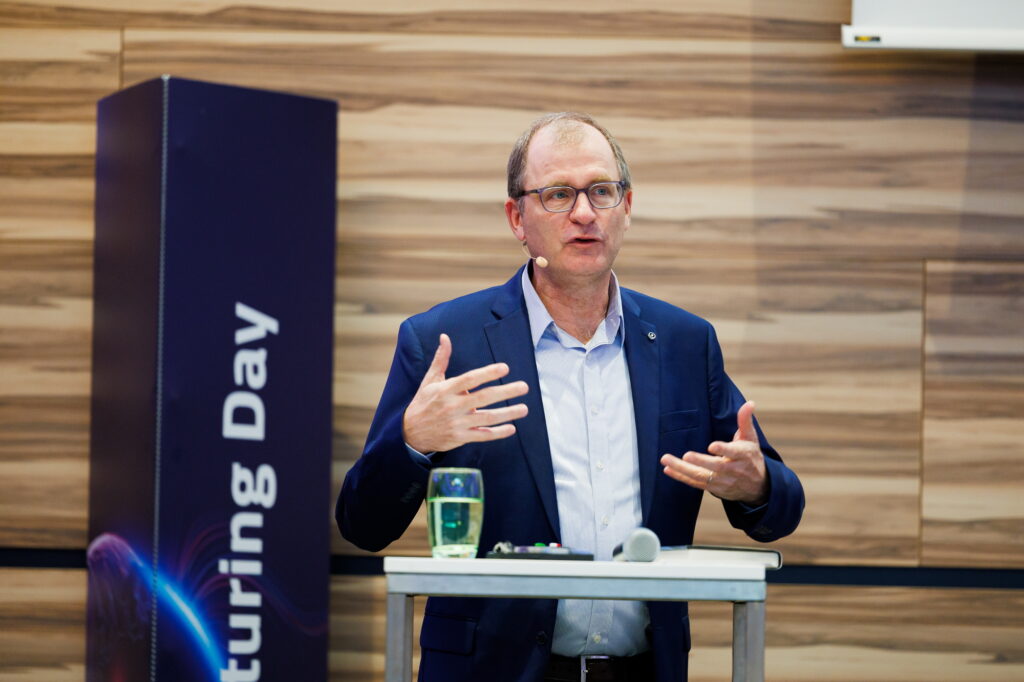
Keynote Speaker at Manufacturing Day 2026: David Mindell, MIT-Professor, Investor, Entrepreneur
Industrial AI meets industrial reality
The discussion deepened during the panel round, “Europe’s scale-up gap: What’s holding back industrial growth?” Joining David Mindell on stage were Kamil Levinský, Managing Partner at Jet Investment, Jasmina Popovska, Head of Investment and International Projects at EIT Manufacturing East, and Arnaud VILLERS d’ARBOUET, CEO of Mecaware. Moderated by Hannes Hunschofsky, Managing Director of EIT Manufacturing East, the panelists explored the realities of scaling manufacturing ventures in a market shaped by geopolitical uncertainty, sustainability pressures, supply chain shifts, and rapid technological change.
Unlike many startup discussions centered on fast growth alone, this panel focused on the unique complexity of industrial scaling. Manufacturing startups do not simply need users, they need factories, infrastructure, supply chains, certifications, industrial customers, and enormous capital investment. Moving from pilot projects to industrial deployment requires long timelines, strategic partnerships, and patient investment structures that Europe is still learning how to support effectively.
At the same time, panelists stressed that Europe possesses many of the ingredients necessary for industrial leadership: strong engineering capabilities, industrial heritage, excellent research institutions, and increasing political momentum around strategic autonomy and resilient production. The question is whether Europe can move quickly enough.
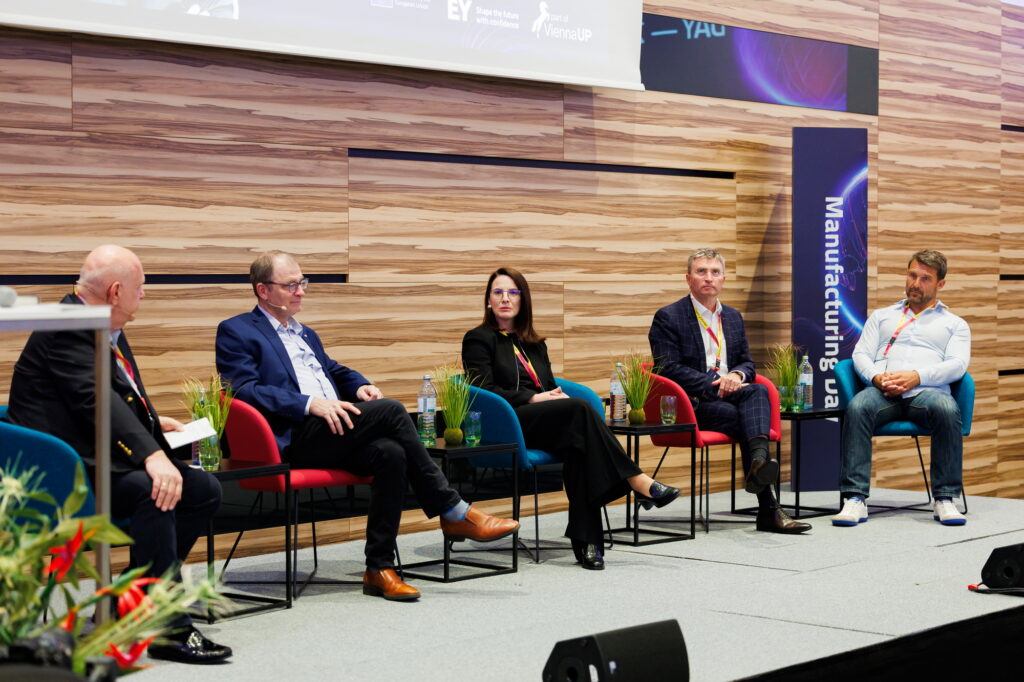
Panel Discussion: Hannes Hunschofsky, David Mindell, Jasmina Popovska, Arnaud Villers d’Arbouet, Kamil Levinský
Research, matchmaking, and new partnerships
Beyond the stage programme, Manufacturing Day 2026 also functioned as a major networking and collaboration platform. The Expo Area showcased cutting-edge European innovation initiatives and research projects, offering participants direct insights into emerging technologies and future industrial developments.
Meanwhile, the matchmaking sessions generated more than 250 business meetings throughout the day, connecting startups with corporates, investors, manufacturing partners, and research organisations from across the globe.
The atmosphere reflected a broader shift happening across the industrial ecosystem: manufacturing innovation is becoming increasingly international, interdisciplinary, and collaborative.
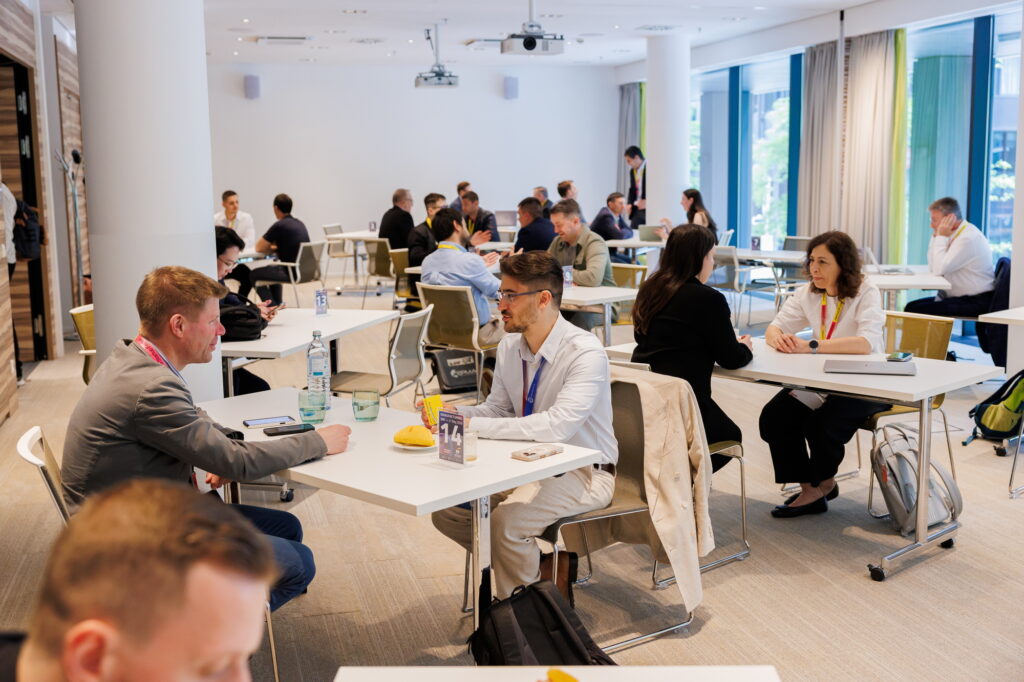
Matchmaking at Manufacturing Day 2026
A new industrialism for Europe
If one idea defined Manufacturing Day 2026, it was this: Europe does not lack innovation. It lacks enough mechanisms to scale industrial innovation into lasting industrial leadership. But in Vienna, at least for one day, the ecosystem working to solve that challenge came together in one place. And judging by the conversations in the halls, the next generation of European manufacturing is already taking shape.
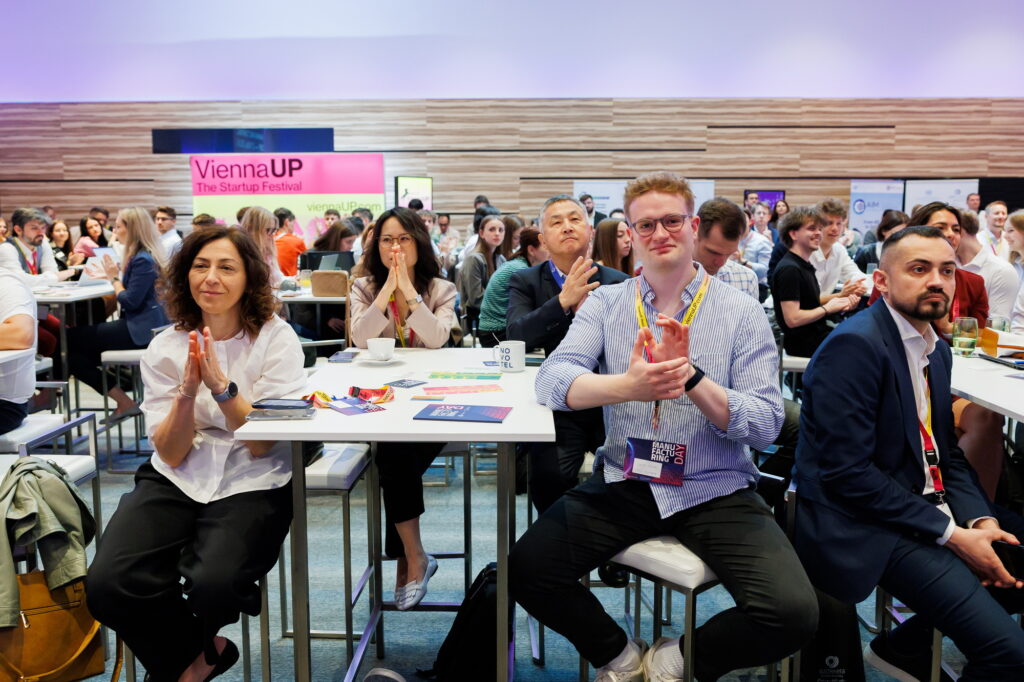
This was Manufacturing Day 2026!
Author: Theresa Neuhauser
ViennaBusiness, Gabriele Tatzberger, Gregor-Robert Posch, Isabella Hermann-Schön, CFA, Round2 Capital Partners, Florian Haas, Mihail Stanev
Projects in the expo: A4M (IFT – Institut für Fertigungstechnik und Photonische Technologien), BLUEVISION, Bridge & Shift, CITADELS – Horizon WIDERA, DATA4CIRC, EU.FFICIENT, PreMETS, Twin City Future Innovation Manufacturing Hub (2C FIMH), VET4DATACOOPERATION, WELDIFY, WELDNET EU Project
EIT Manufacturing East thanks the sponsors of Manufacturing Day 2026:
EY, UNIDO, hannoverimpuls GmbH, De Nora, Infineon, Wirtschaftsagentur Wien, Logiicdev GmbH, Erste Bank und Sparkasse, MOORE SKZ, Connecting World, INDUSTRIEMAGAZIN, The Recursive, ITKeyMedia, Diplomacy & Commerce Austria
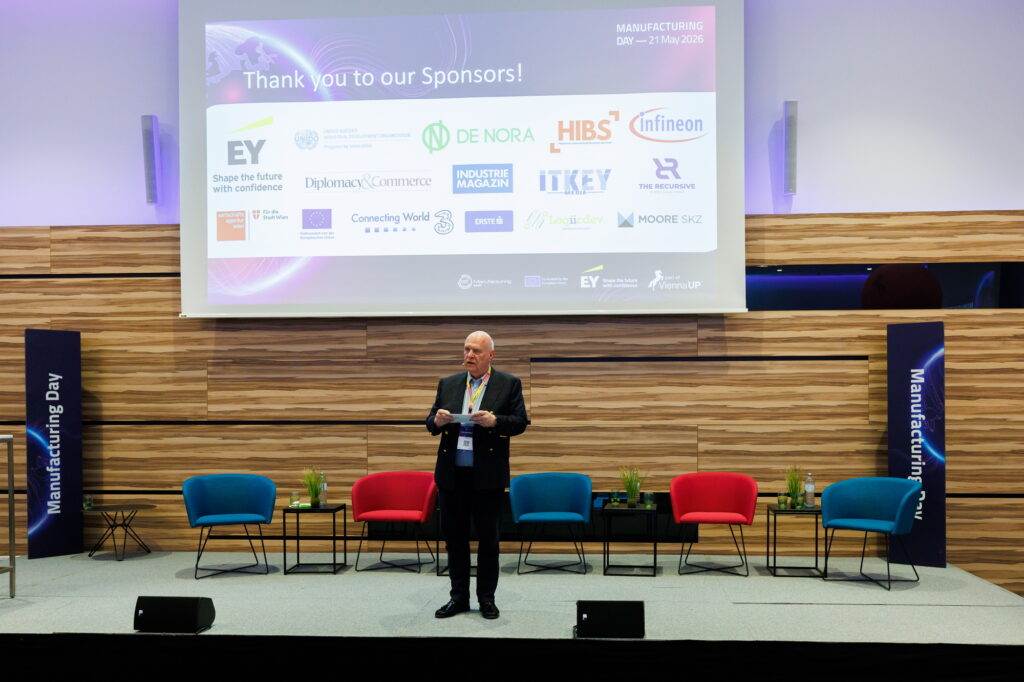
Thank you to our Manufacturing Day Sponsors